
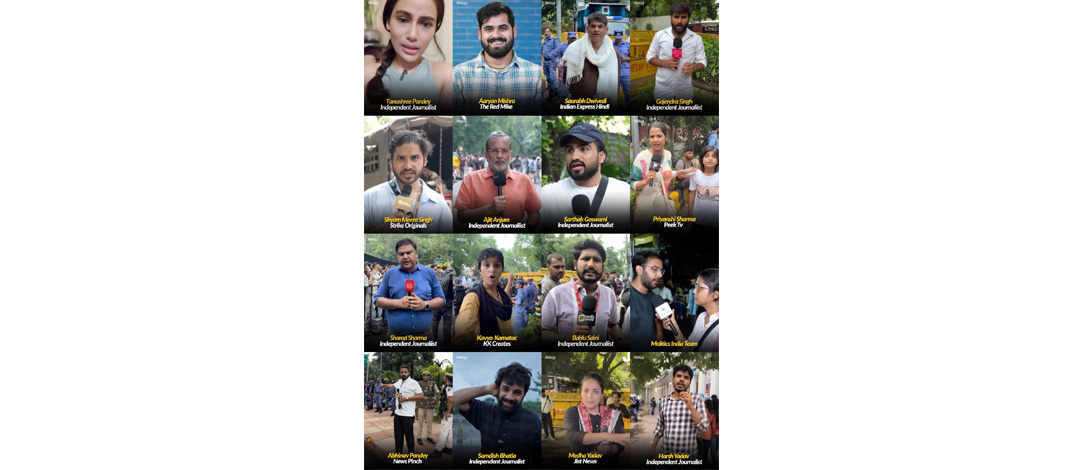
New Delhi: BJP National Information & Technology Department In-charge Amit Malviya has shared a photograph on social media highlighting what he described as the alleged mistreatment of journalists during the recent protest at Jantar Mantar. He claimed that some members of the media were subjected to abuse by protesters and questioned what he termed the selective treatment of journalists.
In a post on X, Malviya said there has been considerable discussion about sections of the media following the Jantar Mantar protest. He argued that it has become common to dismiss journalists or media organisations with differing views by branding them as “godi media.”
According to Malviya, the treatment meted out to some journalists during the protest was unacceptable. He alleged that a few journalists were specifically targeted and that women journalists, in particular, were subjected to abusive and sexually offensive remarks. He said there could be no justification for such behaviour.
At the same time, Malviya claimed that another section of the media appeared to be treated as part of the protest rather than as independent observers. He alleged that while some journalists enjoyed the confidence of the protesters, others were branded and abused. Raising questions over what he described as differing standards, he said that if one group of journalists is labelled “godi media” for allegedly being close to the government, there should also be scrutiny of those perceived to be aligned with protest organisers or a particular political ecosystem.
The BJP leader further stated that such selective criticism of the media was not new. He claimed that even before 2014, there was a group of journalists widely believed to have enjoyed close access to the Congress leadership. According to him, although media platforms and personalities have evolved over the years, the underlying political alignments have largely remained the same, with some journalists moving from television to digital platforms while continuing to display partisan views.
Emphasising the need for consistent standards, Malviya said journalists should not be reduced to political labels merely because they hold different viewpoints. He argued that if media independence is to be upheld as a principle, it should be applied equally to all journalists, irrespective of their perceived political leanings.
Concluding his post, Malviya shared a photograph that he said had been sent to him and asked users on social media to identify the common link among the people featured in the image and suggest who else, if anyone, belonged in the frame or did not.